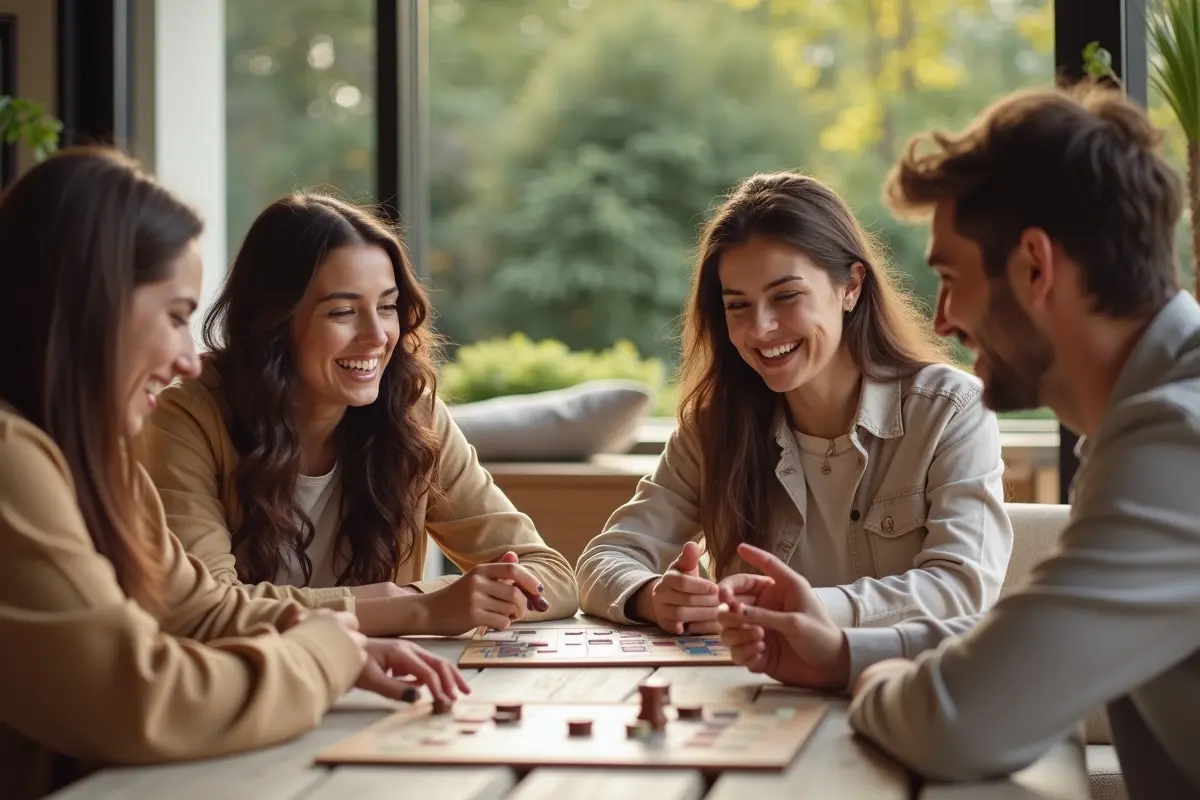
The traditional group dinner has let us down. Guests sit down, order a round of drinks, check out, exhaust their conversational repertoire by the time the second course arrives, and leave having spoken to hardly anyone outside their immediate neighbors. It’s not that we’ve stopped craving real connection; we’ve just been going about it the wrong way.
Why passive settings produce passive conversations
Typical night-out settings concentrate the conversation at one end of the table, where the loudest or most socially dominant people are seated and everyone else competes to be noticed. An activity spreads that playing field evenly across the whole room.
If you pay attention, you’ll notice this in action the next time you’re part of a group heading from a sit-down spot to second location for a game, karaoke, or even another low-key bar. The atmosphere in the new venue is always a little livelier. People are more animated and interactive, and that’s not just because they’ve had a drink or two by then. They’ve experienced that natural, dynamic melting away of conversation barriers, and they’re riding that groove.
This is also why, if you’ve played a team sport or even a good board game, people you only know from that context rarely feel like “work friends” or “gym friends” or “bandmates” to you, even if you’ve never hung out with them outside that shared activity. That’s shorthand for “I like hanging out with these people without needing a specific social lubricant or shared story.”
How neighborhoods and venues are responding
Cities are responding to this trend more quickly than many would think. Take Covent Garden, for example. This cultural hub has managed to merge new concepts with its original charm. Street performances, local dining options, iconic cultural spots combined with new private entertainment areas of such high standards of production constitute different features that occupy the same space.
Booking karaoke in Covent Garden via a private room outlet and remaining in-city is more about sheltering in place while still enjoying all the stimulation offered by the urban landscape. The music pumps out, the screen is massive and all your own, you’re cocooned with friends, not surrounded by strangers. It’s private intensity as opposed to public intoxication, and that’s what satisfies most groups, going out without feeling stranded.
Dubbed “activity as entertainment” by some, it is essentially a strategy that ensures none of the elements of a night out – decor, food, and activity – are designed independently of each other and then glued unenthusiastically together. This is increasingly what people have in mind when they say they’re after “something to do” – a kind of experiential tourism posing as a local hangout that hits all five senses.
The psychology behind why it actually works
The awkwardness that is present during first twenty minutes of any social gathering has a name: social friction. This is the time when nobody is really sure how to vibe together. Ice-breakers in all their forms are designed to simply shorten that time.
Interactive activities do the job of extending the ice breaker for the entire occasion. Friction never gets a chance to creep in since the team is always part of the activity. Engage in something performative or mildly competitive, and shared vulnerability steps up. You get out of your comfort zone and the group doesn’t judge but laughs, and a connection is forged. That is not a byproduct of the scene. That IS the scene.
This is then what is also usually recollected. Behavioral psychology research labels it the peak-end effect. Humans will remember the most dramatic or absurd moment and the way things wrapped up, more than the average stretch. A three-hour dinner rarely produces a peak. A karaoke performance almost always does.
Planning for the full range of personalities
It is not always the most energetic outings that make the best group outings. Not everyone wants to be center stage the entire night, and planning as if they do is how you lose half your group to the corner by 10 p.m.
The best formats tend to mix moments of active participation with low-pressure windows to observe and recover. Karaoke does this well: you can hold the mic when you want it and cheer from the sofa when you don’t. Escape rooms, axe throwing, and competitive bowling offer similar dynamics. You just have to be present – which means looking beyond who seems like they want to be present.
75% of Millennials say they value experiences over physical goods. More to the point, they say they believe that events and outings are more likely to build a sense of shared identity than buying stuff (Eventbrite). This may not sound like a high bar but scroll through your IG and count the number of friends you have who bought a gym membership. The prevailing logic is that when you can point to a picture and say, “We were there,” it means you were there. And not just physically.
What this means for how we plan evenings
The structure of an evening isn’t a non-factor. It determines what sort of talk you can have, who will participate, and what folks will recollect. Opting for an activity-based environment isn’t an evasion of refined sipping-room standards: it’s just understanding that the best kind of visceral, weird, electric humanness isn’t generated in a vacuum. It takes constraints, and stakes, and something everyone can get into.